

How to Harvest Mesquite Gum: A Local Alternative to Gum Arabic
This page may contain affiliate links. Learn more.
If you live in Arizona or another dry desert region, you may not have to order gum arabic from halfway around the world.
Our native mesquite trees produce their own natural gum—a clear to amber-colored substance that oozes from the branches and hardens into little glassy lumps. Around the Southwest, this is often called mesquite sap, but botanically it is more accurately described as mesquite gum, or a gum exudate.
And it turns out that mesquite gum has a lot in common with gum arabic.
For anyone interested in making natural paints, inks, dyes, or other traditional crafts from locally available materials, mesquite gum is a fascinating desert resource.

FORAGING
PRESERVING
WILDCRAFT
PREPARE
Mesquite Gum Is Surprisingly Similar to Gum Arabic
Gum arabic is a natural gum made from the dried sap of certain acacia trees, particularly Acacia senegal and Acacia seyal, which grow primarily in the Sahel region of Africa.
I’ve always heard of gum arabic, but didn’t realize its significance throughout history. People have been using gum arabic for thousands of years. Ancient Egyptians used acacia gum in inks and other crafts, and it eventually became an important trade commodity moving through the Middle East and into Europe. The name “gum arabic” comes from this history of trade through Arab ports.
Today, gum arabic is probably most familiar to artists as the binder used in watercolor paint. It allows pigment to remain suspended in water and then bind to paper as the water evaporates. This is how I’m going to be using it.

It is also used in:
- Watercolor and gouache
- Ink making
- Lithography and printmaking
- Food and confectionery
- Beverages
- Pharmaceuticals
- Cosmetics
- Adhesives
- Emulsions and coatings
The reason gum arabic is so useful is that it is water-soluble, unlike pine resin, and acts as a binder, stabilizer, emulsifier, and film-forming material.
So what does all of this have to do with a mesquite tree growing in your backyard?

Mesquite Gum Is Surprisingly Similar to Gum Arabic
Mesquite gum comes from the genus Prosopis, which includes our familiar desert mesquite trees.
When the tree produces an exudate, it eventually dries into hard, translucent nodules of gum. In Sonora, this traditional resource is known as chúcata.
Research comparing mesquite gum with gum arabic has found striking similarities. Both are complex plant gums containing arabinose and galactose, and both have water-soluble, film-forming and emulsifying properties.
One study specifically comparing mesquite gum from northwestern Mexico with commercial gum arabic found that the two gums had closely related carbohydrate and protein components and similar functional properties. The researchers concluded that mesquite gum could potentially serve as a replacement for gum arabic in regions where mesquite is abundant.
That makes a lot of sense when you look at the trees themselves.
Gum arabic comes from an arid-region tree.
Mesquite gum comes from an arid-region tree.
Both trees produce a water-soluble gum as a response to environmental stress or injury.
And both gums can be collected, dried and dissolved in water.
For those of us living in the Sonoran Desert, mesquite gum is a particularly interesting example of a local alternative to an imported material.

Where Does Mesquite Gum Come From?
Mesquite gum forms inside the tree and emerges through the bark, often around natural wounds, damaged areas, insect activity, or other places where the tree has been stressed. Heat and drought can also encourage exudation.
The result is a small blob or nodule of gummy material that starts out soft or sticky and eventually becomes hard and glass-like.
The National Park Service notes that amber globules of mesquite sap can be collected from mesquite branches during the warm months and that the material has a texture similar to gum arabic.

When to Harvest Mesquite Gum
In the Sonoran region, traditional production of mesquite gum generally occurs during the late spring and summer, with May through July identified as an important collection period before the summer rains.
In Arizona, your exact timing will depend on weather, the individual tree, and how much stress the tree has experienced.
The easiest way to find out if your trees are producing gum is simply to start looking.
Check the branches and smaller limbs for:
- Clear or amber-colored lumps
- Hardened, glassy droplets
- Sticky areas that have dried into translucent pieces
- Gum around naturally damaged areas of the bark
You may find only a few pieces on one tree and quite a bit on another.
That’s normal. Mesquite gum production varies considerably with weather, tree health, age, and growing conditions. Look on the ground around the trunk to find dried sap that has collected there. Ants love it, so watch where they go.

mesquite-gum-seeping-out-of-a-tree

raw-and-ground-mesquite-gum

grinding-mequite-gum

ground-mesquite-gum
How to Harvest Mesquite Gum
1. Look for naturally occurring gum
Start by inspecting the branches of a mesquite tree.
I prefer to collect gum that the tree has already produced rather than deliberately cutting or damaging the bark to encourage more production.
Mesquite gum has historically been collected from wounds and damaged areas of trees, and older sources describe making small incisions to increase production. But there is really no reason for a backyard harvester to injure a healthy tree just to obtain a little gum.
Let the tree do the work.
2. Choose clean, amber-colored pieces
Look for pieces that are relatively clean and have a clear, golden, amber, or reddish-amber appearance.
The cleaner the gum is when you collect it, the less work you’ll have later.
Avoid pieces that are heavily covered with:
- Dirt
- Bark
- Insects
- Mold
- Bird or animal droppings
- Other obvious contaminants
Mesquite gum has traditionally been graded partly according to its color, size, integrity, and amount of bark or other foreign material. Lighter, intact amber nodules are generally considered higher quality.
3. Gently remove the gum
Use clean hands or a small clean tool to lift the hardened gum from the branch.
You don’t need to dig into the bark.
The pieces can be surprisingly hard, almost like little pieces of amber or glass.
Collect them in a clean container as you go.
4. Sort your harvest
Once you’re home, spread the gum out and take a closer look.
Pick out pieces containing large amounts of bark or other debris.
You can also separate the lighter amber pieces from very dark pieces.
The darker gum may contain higher concentrations of tannins, so if you’re experimenting with mesquite gum for artistic purposes, starting with clean, light-colored gum will give you a more predictable material.
5. Clean the gum
For craft use, I would keep the cleaning process simple.
Remove visible bark and debris by hand. If necessary, quickly rinse the pieces with clean water and allow them to dry completely.
Do not store the gum until it is thoroughly dry.
Once dry, you can leave the pieces whole or grind them into smaller pieces or a powder.
A mortar and pestle works well for small amounts.

How to Use Mesquite Gum as a Gum Arabic Substitute
This is where it gets really interesting.
Because mesquite gum is water-soluble, you can dissolve the dried gum in water and use the resulting solution much like a gum arabic solution.
I recommend starting with small batches because the concentration and behavior of naturally collected gum can vary.
Put a small amount of crushed mesquite gum into a clean glass container and add water.
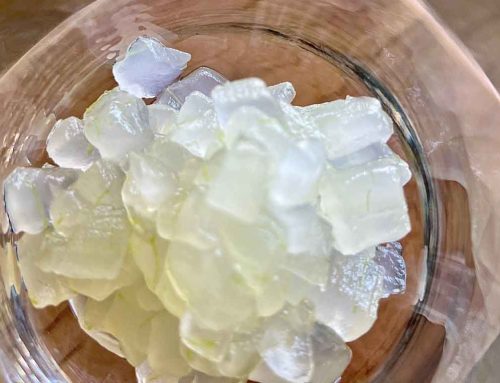
Allow it to sit and soften, then stir occasionally until the gum has dissolved. It will be gelatinous.
If you have a lot of bark or other insoluble material in your harvest, strain the solution through a fine cloth or filter.
You can then experiment with your mesquite gum solution as a binder for:
- Homemade watercolor
- Natural pigments
- Botanical inks
- Desert plant inks
- Natural paints
- Drawing materials
The exact concentration you want will depend on what you’re making. A watercolor binder needs to behave differently from an ink binder, so I would treat your first batch as an experiment rather than trying to duplicate a commercial gum-arabic recipe exactly.

Mesquite Gum for Natural Paints and Inks
I discovered that mesquite sap was an excellent substitute for gum arabic when I was researching how to make traditional archival ink (like that used to make the magna carta and declaration of Independence). The basic ingredients were oak galls (which I replaced with red dock root because of it’s high tannin content), iron water and gum arabic. As usual, I had to check to see if any of our native trees had sap that could be used. As you have now discovered, I did.
When making inks and paints from natural materials we need something to hold those tiny particles together and help them adhere to paper.
That’s exactly the sort of job gum arabic has traditionally performed.
Mesquite gum gives us a way to look much closer to home.
Instead of ordering a little bottle of gum arabic for a project, you can walk outside and look at the mesquite trees growing around you.
Historically, desert peoples also used mesquite gum and other parts of the tree for paints, dyes, food, and medicinal purposes. The National Park Service documents the use of mesquite exudates for paint, dye, and traditional medicinal preparations, while historical and scientific literature documents mesquite gum as a traditional food and medicinal material in the Southwest and northern Mexico.
A Few Things to Keep in Mind
Know your tree. Make sure you’re actually harvesting from a Prosopis mesquite and not another desert tree producing a similar-looking substance.
Don’t damage healthy trees unnecessarily. Natural exudate is the easiest and most sustainable material to collect on a small scale.
Keep your harvest clean. Gum collected from exposed branches can pick up dust, insects, bird droppings and other contaminants.
Start with small amounts. Mesquite gum production can be surprisingly limited. Studies in Sonora have found that only a portion of trees produce gum in a given period, and yields can vary considerably.
Look for Gum on Your Own Mesquite Trees
One of the things I love about living in the desert is discovering that so many of the things we normally buy have a local counterpart growing right outside our doors.
Gum arabic comes from trees.
So does mesquite gum.
One comes from acacias growing in the dry regions of Africa and elsewhere. The other comes from Prosopis growing right here in the Southwest.
And scientists have confirmed what desert people have known for generations: mesquite gum has many of the same chemical and functional characteristics that make gum arabic useful.
The next time you’re walking beneath a mesquite tree, look up at the branches.
Those little amber lumps aren’t just sap.
They’re a traditional desert material—and potentially a local gum arabic alternative hiding in plain sight.

Homesteading Resources

Gaia’s Garden
Toby Hemenway

Southwest Foraging
John Slattery

Southwest Medicinal Plants
John Slattery

Medicinal Plants of the American Southwest
Charles Kane
Pin Me!


Subscribe & Receive A Free Garden Guide
Keep in touch with our weekly newsletter and receive a FREE digital, printable garden guide to help you get the most out of your own backyard.
We do not spam. You can unsubscribe anytime




Leave A Comment